 |
| People of Peru by Nina (4) |
But the population of this country is actually a mixture of people coming from several origins. That is why today's Peru population is the representation of not only the Amerindians but also the Asian, African and some other races. Since Peru has a multi ethnic population, its culture and other aspects of general life are also reflective of a variegated cultural pattern.
Peru population reflects multicultural pattern and activities. At present, this South American country stands in the thirty eight position in the whole world, among 193 countries, regarding its population. Peru population, as its demographical study shows, is 27,167,000 in 2003. Peru's population is a little over a quarter of what the US population of 307,006,550 is. In Peru's population there are almost 30.9% people who are below fourteen years of age. People who have age within fifteen to sixty years, comprises almost 63.7% among the whole population and people more than sixty five years of age comprises of 5.3% of the total population. Population growth in this country as is estimated in 2006 is 1.32%. (3) the 2007 Census the region numbers were Roman Catholic 81.3%, Evangelical 12.5%, other 3.3%, unspecified or none 2.9%. (5)
Major Cities in Peru
Lima, established in the time of the Spanish conquerors, is the capital of Peru and has the largest population by far. A list of the cities by population are listed below.

Major cities in Peru (7)
Agriculture in Peru
Obstacles to increasing agricultural production include the poor quality of much of the country's land and the high degree of dependence on erratic supplies of water, plus the negative effects of public policies toward agriculture. (2) Peru's malnutrition rate began falling in 2005, when the government introduced a coordinated strategy focusing on hygiene, sanitation, and clean water. School enrollment has improved, but achievement scores reflect ongoing problems with educational quality. Many poor children temporarily or permanently drop out of school to help support their families. About a quarter to a third of Peruvian children aged 6 to 14 work, often putting in long hours at hazardous mining or construction sites. (5)
We can now date the emergence of irrigation and canal systems to the second millennium BC. With increased productivity through irrigation, societies were able to dedicate more of their time to building, producing textiles and making pottery, thereby opening up possibilities for the trade of such products with other communities and creating the basis of a Pan-Andean culture that would lead to the emergence of the Inca Empire in the 15th century.
Agricultural terracing conquered the steep slopes for the sowing of corn in the valleys and potatoes on the higher slopes, and stone-lined canals brought water down from the glacial peaks of the sacred mountains. Meanwhile, expert agronomists continually domesticated new crops, developing new strains to increase yields at agricultural research stations like Moray, above the Sacred Valley of the Incas, where descending concentric terraces mimic the many ecological floors and varying temperatures found throughout the Cusco region.
(3)
Peru's malnutrition rate began falling in 2005, when the government introduced a coordinated strategy focusing on hygiene, sanitation, and clean water. School enrollment has improved, but achievement scores reflect ongoing problems with educational quality. Many poor children temporarily or permanently drop out of school to help support their families. About a quarter to a third of Peruvian children aged 6 to 14 work, often putting in long hours at hazardous mining or construction sites. (5)
Industry in Peru
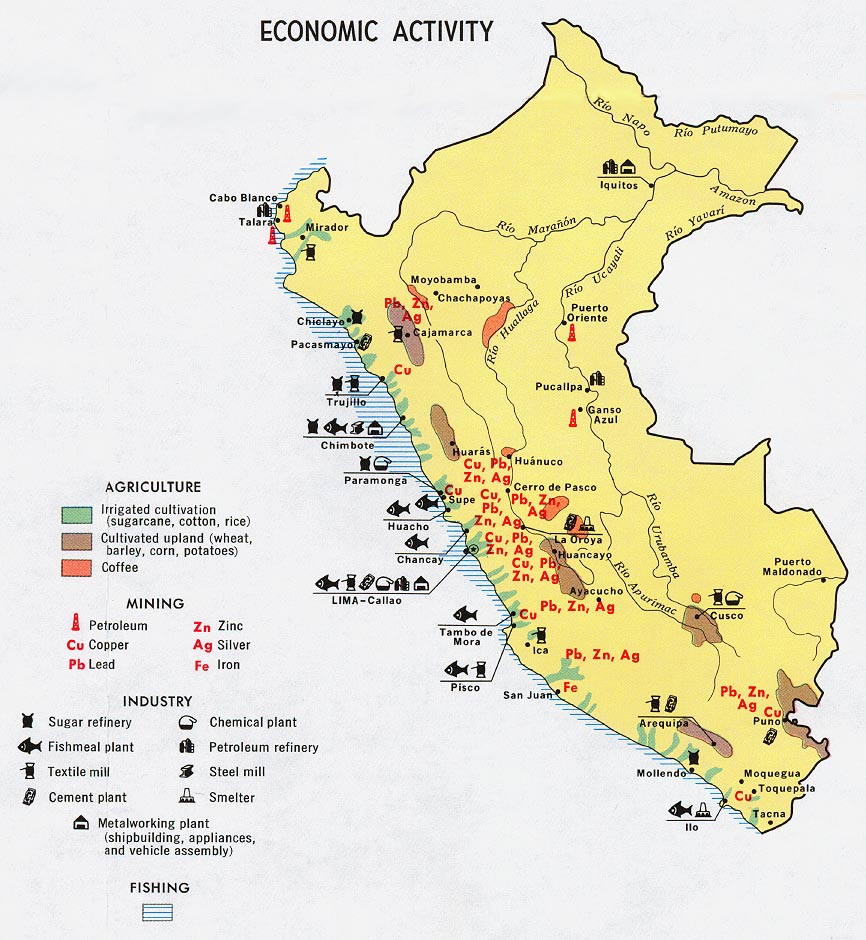
The major industries in Peru consist of Fishing, Mining and manufacturing. Peru leads internationally in fishing because of the cold-water Humboldt Current bring rich water that create ideal fishing grounds. Peru exported more than US$1 billion in fish products in 2000 but come in 2nd to the mining industry. (8)
This is where my company comes in in the construction documents for mining in some of Peru's rich mineral sites. Mineral exports are key to Peru's economy representing nearly half of Peru's exports in 2000. The Andes are rich in minerals and gold, and silver pieces can be found in numerous pre-Columbian societies. Peru ranks eighth worldwide in gold production (first in Latin America), second in copper, and among the top 5 producers of lead and zinc. Two of Peru's gold mines, Yanacocha and Pierina, are among the most productive and profitable gold mines in the world. Peru has an estimated 21 million fine ounces of gold reserves in mines currently under operation and 42 million fine metric tons of copper reserves. An additional 100 gold mines are predicted to come on line in the next 5 years. (8)
Both mining and fish are not labor intensive fields but the manufacturing industry is big on the use of the Peruvian citizens. Peru exported nearly US$700 million in garments in 2000, mainly to the United States and Europe. Peruvian garment makers generally produce high-end products for the U.S. markets, including brand names such as Ralph Lauren, Brooks Brothers, and Bobby Jones. (8)
Tourism in Peru
Peru is a beautiful and colorful place to visit from the world wonder of the ancient Inca citadel of Machu Picchu, in Cuzco to the just relaxing on Titicaca Lake in Puno. There is something for everyone, depending on what they want to see, what type of terrain they want to experience and climate as well.
Planning a visit, check out http://visitperu.com/
Holidays and Cultural Activities in Peru

The major industries in Peru consist of Fishing, Mining and manufacturing. Peru leads internationally in fishing because of the cold-water Humboldt Current bring rich water that create ideal fishing grounds. Peru exported more than US$1 billion in fish products in 2000 but come in 2nd to the mining industry. (8)
 |
| Economy in Peru - 1970 (9) |
Both mining and fish are not labor intensive fields but the manufacturing industry is big on the use of the Peruvian citizens. Peru exported nearly US$700 million in garments in 2000, mainly to the United States and Europe. Peruvian garment makers generally produce high-end products for the U.S. markets, including brand names such as Ralph Lauren, Brooks Brothers, and Bobby Jones. (8)
Tourism in Peru
Peru is a beautiful and colorful place to visit from the world wonder of the ancient Inca citadel of Machu Picchu, in Cuzco to the just relaxing on Titicaca Lake in Puno. There is something for everyone, depending on what they want to see, what type of terrain they want to experience and climate as well.
Planning a visit, check out http://visitperu.com/
Holidays and Cultural Activities in Peru
Holidays and festivities in Peru a are extensive because of the many different races. For the most part they are the same holidays as the US with the exception of Independence days and a few other Peru Specific days.
Incomplete holidays in Peru (6)
Credits:
(1) http://www.mapsofworld.com/peru/population.html
(2) http://countrystudies.us/peru/54.htm
(3) http://www.andeantravelperu.com/en/activities/agro_tourism/mf_agriculture_peru.php
(4) http://www.flickr.com/photos/24939776@N07/4164521072/
(5) https://www.cia.gov/library/publications/the-world-factbook/geos/pe.html
(6) http://en.wikipedia.org/wiki/Public_holidays_in_Peru
(7) http://www.inside-peru.com/major-cities-in-peru.html
(8) http://www.nationsencyclopedia.com/economies/Americas/Peru.html
(9) http://www.zonu.com/imapa/americas/Peru_Economic_Activity_Map_2.jpg
(1) http://www.mapsofworld.com/peru/population.html
(2) http://countrystudies.us/peru/54.htm
(3) http://www.andeantravelperu.com/en/activities/agro_tourism/mf_agriculture_peru.php
(4) http://www.flickr.com/photos/24939776@N07/4164521072/
(5) https://www.cia.gov/library/publications/the-world-factbook/geos/pe.html
(6) http://en.wikipedia.org/wiki/Public_holidays_in_Peru
(7) http://www.inside-peru.com/major-cities-in-peru.html
(8) http://www.nationsencyclopedia.com/economies/Americas/Peru.html
(9) http://www.zonu.com/imapa/americas/Peru_Economic_Activity_Map_2.jpg

No comments:
Post a Comment